Normal Delivery vs C-Section: What Every Expecting Mother Should Know

Gallstones and Hernia: Two Common General Surgery Problems Explained
September 16, 2026
Migraine and Chronic Headaches: Causes, Triggers, and Neurology Treatment Options
September 16, 2026
Learn the key differences between normal delivery and C-section, including benefits, recovery, risks, and when each delivery method is recommended. TrustMed Hospital provides expert maternity and neonatal care in Badshahpur, Gurugram.
Few decisions during pregnancy generate as much anxiety, opinion, and misinformation as the question of how you’ll deliver your baby. Family members have strong opinions, friends share their own experiences as if they apply universally, and social media adds even more noise. The truth is that the choice around normal delivery vs C-section Gurgaon doctors help you make isn’t really a lifestyle preference — it’s a medical decision that depends on your health, your baby’s position and condition, and how labor progresses. This guide breaks down both options clearly so you can have an informed conversation with your doctor instead of relying on guesswork.
What Is a Normal (Vaginal) Delivery?
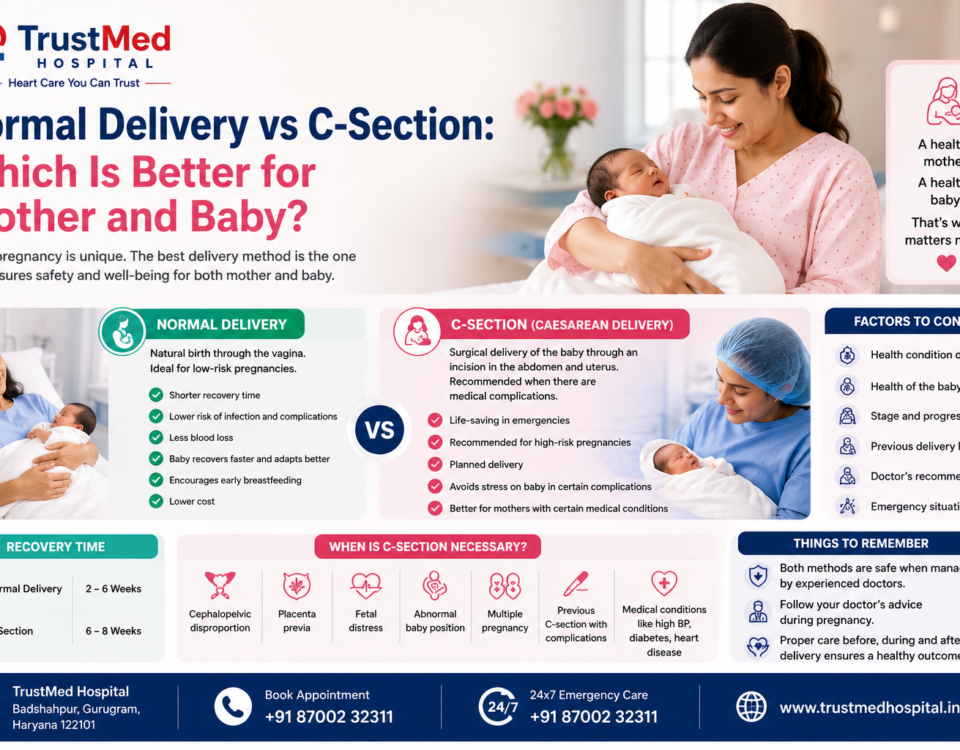
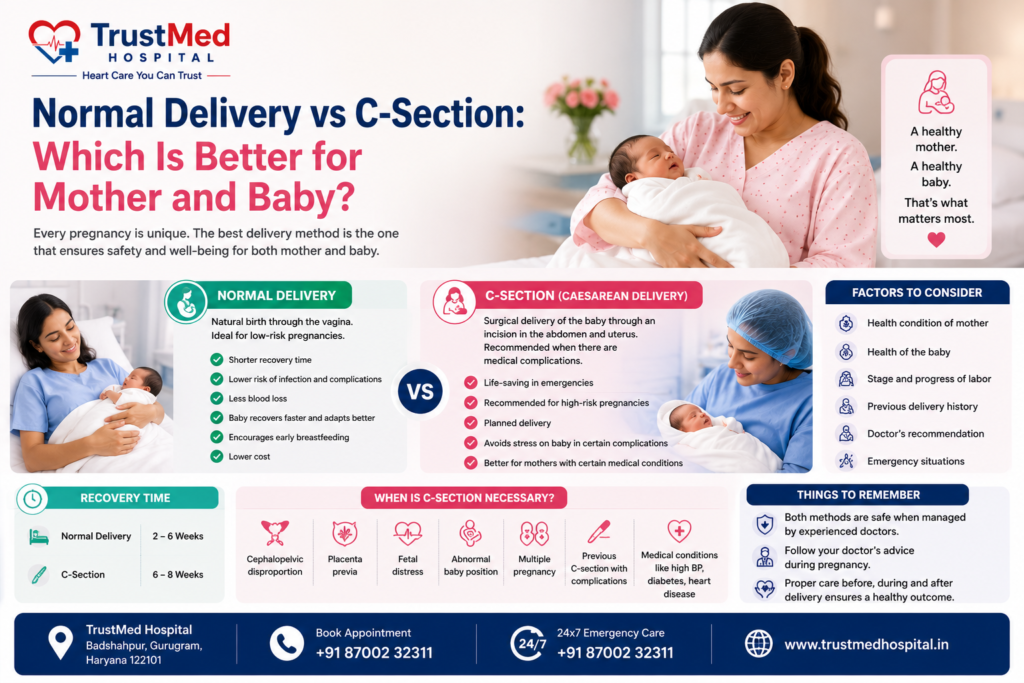
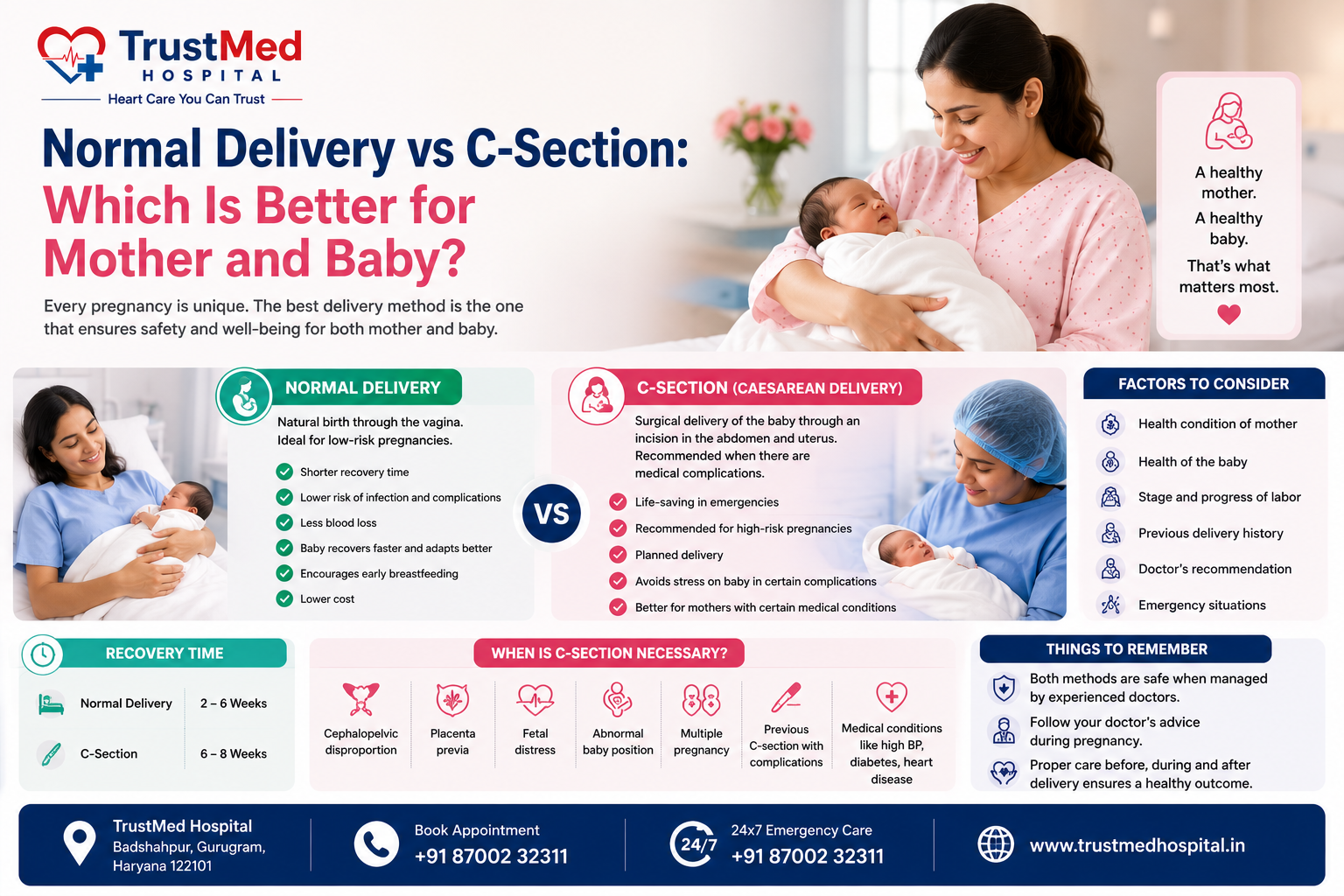
A normal delivery is the natural process of childbirth through the birth canal, without surgical intervention. It happens in stages: early labor, active labor, and delivery, followed by the delivery of the placenta. For most low-risk pregnancies, this is the safest and most recommended route, and it comes with several well-documented advantages.
Benefits of Vaginal Delivery
- Shorter hospital stay — most mothers can go home within 1-2 days if there are no complications.
- Faster physical recovery — women are typically up and moving within hours, with less post-delivery pain than after major surgery.
- Lower risk of surgical complications — no risk of surgical site infection, and no abdominal incision to heal.
- Immediate skin-to-skin contact is often easier to establish, which supports early bonding and breastfeeding initiation.
- Lower risk in future pregnancies — vaginal delivery doesn’t carry the scar-related risks (like placenta accreta or uterine rupture) that repeat C-sections can pose.
When Vaginal Delivery May Not Be Recommended
Not every pregnancy is a candidate for vaginal delivery. Your doctor may recommend against it if there’s:
- A baby positioned feet-first (breech) or sideways (transverse) close to delivery.
- Placenta previa, where the placenta covers the cervix.
- Signs of fetal distress during labor.
- A significantly narrow pelvis relative to the baby’s size.
- Certain maternal health conditions, like active infections that could be transmitted during vaginal birth.
What Is a C-Section (Cesarean Delivery)?
A cesarean section is a surgical procedure where the baby is delivered through incisions made in the mother’s abdomen and uterus. It can be planned in advance (elective) or performed urgently during labor if complications arise (emergency C-section).
When a C-Section Is Medically Necessary
According to the WHO’s data on caesarean sections, the procedure is a vital, life-saving intervention when medically indicated, and common reasons include:
- Prolonged or obstructed labor that isn’t progressing despite adequate time and effort.
- Fetal distress — signs the baby isn’t tolerating labor well.
- Breech or transverse presentation near the due date.
- Placenta previa or placental abruption.
- Multiple pregnancies (twins or more) in certain positions.
- A previous C-section, depending on the reason for the first one and the type of uterine incision used.
- Maternal health conditions such as severe pre-eclampsia or certain heart conditions where labor could pose a risk.
What Recovery Looks Like After a C-Section
As described by the NHS’s overview of caesarean section recovery, a C-section is major abdominal surgery, and recovery reflects that. Most mothers stay in the hospital for 3-4 days, and full recovery — including a return to normal activity and lifting — typically takes 4-6 weeks. Pain at the incision site, restricted movement in the first days, and a longer path back to full mobility are common, which is why post-operative support at home matters more after a C-section than after a vaginal birth.
Comparing the Risks: Normal Delivery vs C-Section Gurgaon Mothers Should Weigh
Both delivery methods carry their own risk profile, and neither is universally “safer” — it depends entirely on the individual pregnancy.
Risks more associated with vaginal delivery:
- Perineal tearing, which usually heals well but can cause discomfort.
- Longer, more unpredictable labor duration.
- In rare cases, the need to switch to an emergency C-section if complications develop mid-labor.
Risks more associated with C-section:
- Higher risk of surgical site infection.
- Longer hospital stay and recovery time.
- Increased bleeding compared to vaginal delivery, on average.
- Higher risk of complications in future pregnancies, including placenta-related issues if multiple C-sections are performed.
The American College of Obstetricians and Gynecologists (ACOG) notes that while C-sections are very safe overall, they are still major surgery and are recommended specifically when the benefits outweigh the risks of continuing with labor — not as a routine alternative to vaginal birth.
Can You Have a Vaginal Birth After a Previous C-Section (VBAC)?
Many women assume that once you’ve had a C-section, all future deliveries must also be C-sections. This isn’t always true. A vaginal birth after cesarean (VBAC) is possible for many women, depending on the type of uterine incision from the previous surgery, the reason it was performed, and how the current pregnancy is progressing. This decision requires careful evaluation with your obstetrician, as it does carry a small risk of uterine rupture, but for the right candidates it’s a safe and viable option that avoids repeat major surgery.
How Doctors Help You Decide
A responsible approach to birth planning isn’t about pushing one method over another — it’s about continuously assessing the pregnancy and adjusting the plan as needed. Our gynecology and maternity department works with expecting mothers throughout pregnancy to monitor factors like baby’s position, growth, and maternal health, updating the delivery plan as the due date approaches rather than locking in a decision too early. Weighing normal delivery vs C-section Gurgaon obstetricians recommend always starts with this kind of ongoing assessment.
Conditions diagnosed earlier in pregnancy — including hormonal conditions like PCOS that affect pregnancy planning — are also factored into how a pregnancy is monitored and managed as it progresses, since they can influence risk levels for both mother and baby.
Preparing for Either Outcome
One of the most reassuring pieces of advice obstetricians give is to prepare mentally and practically for both possibilities. Labor doesn’t always go as planned, and even mothers hoping for a vaginal delivery should understand what an emergency C-section would involve, so it doesn’t feel like a frightening surprise if it becomes necessary.
Regardless of delivery method, having access to round-the-clock support matters. Our 24/7 emergency obstetric care ensures that if labor doesn’t progress as expected, a swift, well-coordinated response is always available.
Care After Delivery: For Mother and Baby
Whichever way your baby arrives, the days and weeks that follow are just as important as the delivery itself. If your baby needs extra monitoring after birth, our NICU support for newborns provides specialized care for babies who need it. For all new parents, our guide on caring for your baby in the first month covers feeding, sleep, and the early adjustments every family goes through, regardless of delivery type.
For India-specific guidance on maternal and newborn health services, the Ministry of Health and Family Welfare and organizations like the Federation of Obstetric and Gynaecological Societies of India (FOGSI) publish extensive resources for expecting families.
Frequently Asked Questions
Is a C-section less painful than a normal delivery?
Labor pain and surgical recovery pain are different experiences, not a simple “more or less.” Vaginal delivery involves pain during labor that eases quickly afterward, while a C-section avoids labor pain but comes with a longer surgical recovery.
Can I request a C-section without a medical reason?
Elective C-sections without medical indication are sometimes performed, but most obstetricians recommend a thorough discussion of the risks and benefits first, since vaginal delivery is generally associated with fewer complications when there’s no medical reason to avoid it.
How soon can I get pregnant again after a C-section?
Most doctors recommend waiting at least 12-18 months before the next pregnancy to allow the uterine scar to heal fully, reducing the risk of complications in the next pregnancy.
Does a C-section affect breastfeeding?
It can delay the start slightly due to recovery and mobility, but with proper support, most mothers who’ve had a C-section breastfeed successfully. Early skin-to-skin contact, even after surgery, helps establish breastfeeding.
Whatever path your delivery takes, having a team that monitors your pregnancy closely and adapts the plan as needed makes all the difference. Deciding between normal delivery and C-section in Gurgaon shouldn’t be a guessing game. Connect with our gynecology and maternity team at TrustMed Hospital to discuss your birth plan and get answers specific to your pregnancy.