Medical Emergency in Badshahpur? What to Do in the First 60 Minutes (Hour)

When Does a Newborn Need NICU Care? A Parent’s Guide
July 29, 2026
Heart Attack Symptoms in Women: Signs You Should Never Ignore
July 30, 2026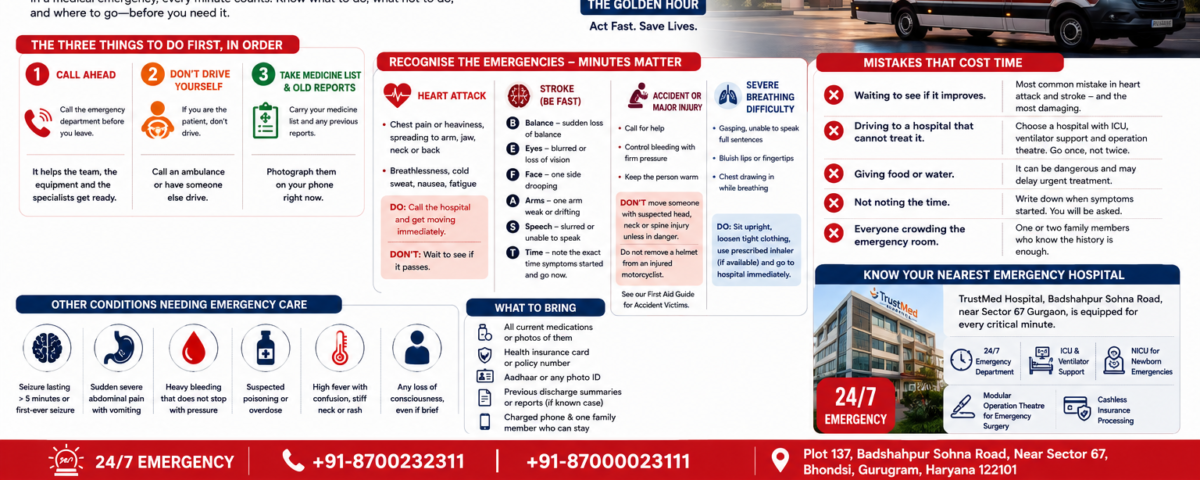
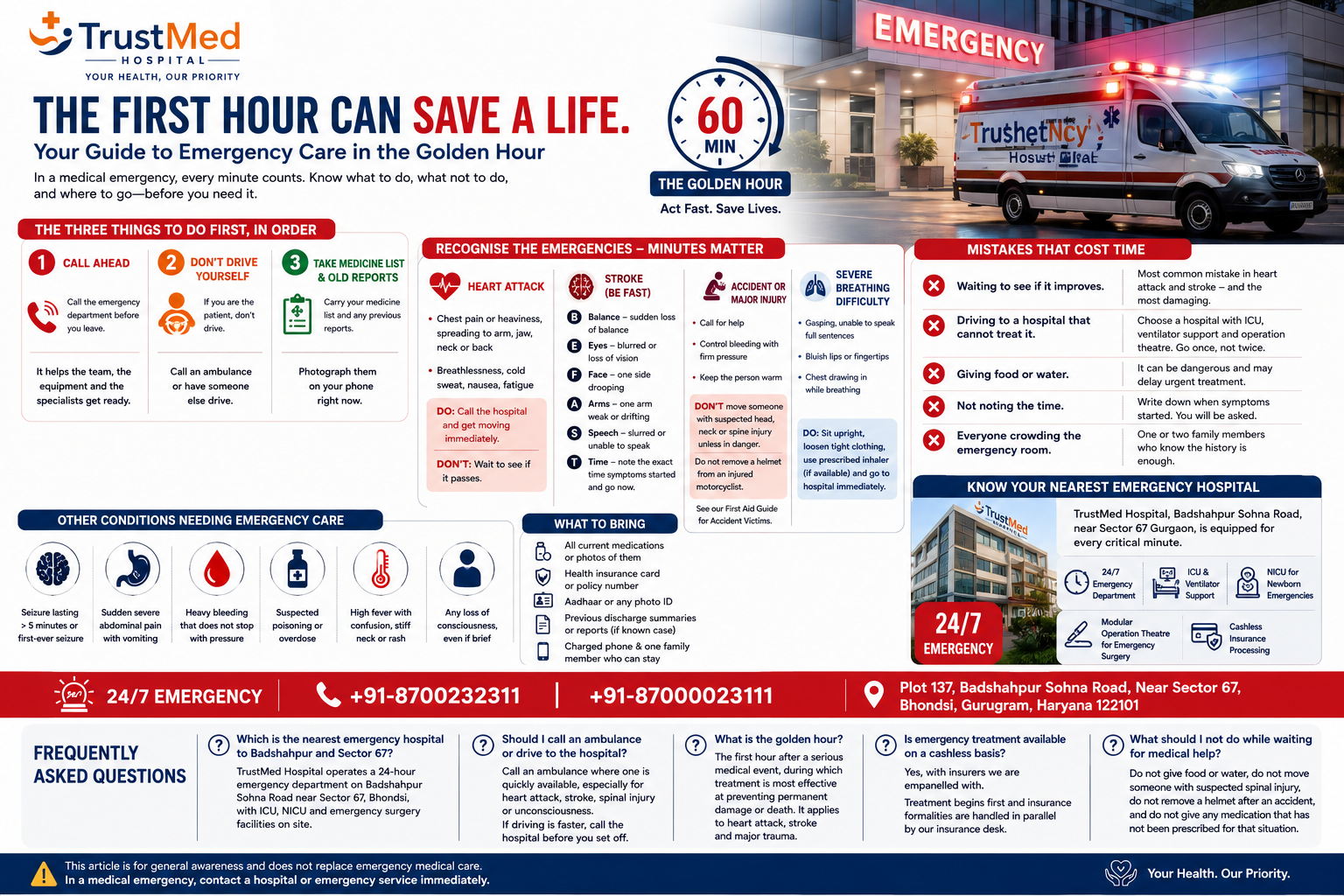
In a serious medical emergency, the first hour usually determines the outcome. Clinicians call it the golden hour — the window in which treatment for a heart attack, stroke, major bleeding or severe trauma is most likely to prevent lasting damage. Knowing your nearest emergency hospital in Badshahpur before you ever need it is part of being ready for it.
The problem is that the first hour is also when families are least able to think clearly. Decisions get made in a panic: which hospital, whose car, what to bring, who to call. Along the Badshahpur–Sohna Road corridor, traffic can turn a short distance into a long one, and knowing in advance where your nearest emergency hospital in Badshahpur is can save the minutes that matter most.
This guide covers what to do — and what not to do — in the first hour.
The three things to do first, in order at the time of emergency
1. Call ahead. Phone the emergency department before you leave. A hospital that knows a suspected cardiac case is arriving in ten minutes can have the team, the ECG and the cath lab pathway ready when you arrive rather than starting from scratch at the door. This one call frequently saves fifteen to twenty minutes of critical time.
2. Do not drive yourself if you are the patient. People having heart attacks and strokes lose consciousness. Every year people collapse at the wheel on the way to hospital. Call an ambulance, or have someone else drive.
3. Take the medicine list and any old reports. Photograph the strips of every regular medication on your phone right now — before you ever need to. In an emergency, being able to show the treating doctor exactly what someone takes for blood pressure, diabetes or blood thinning changes what can be given safely, immediately. The World Health Organization notes that heart attack and stroke require prompt management to limit damage.
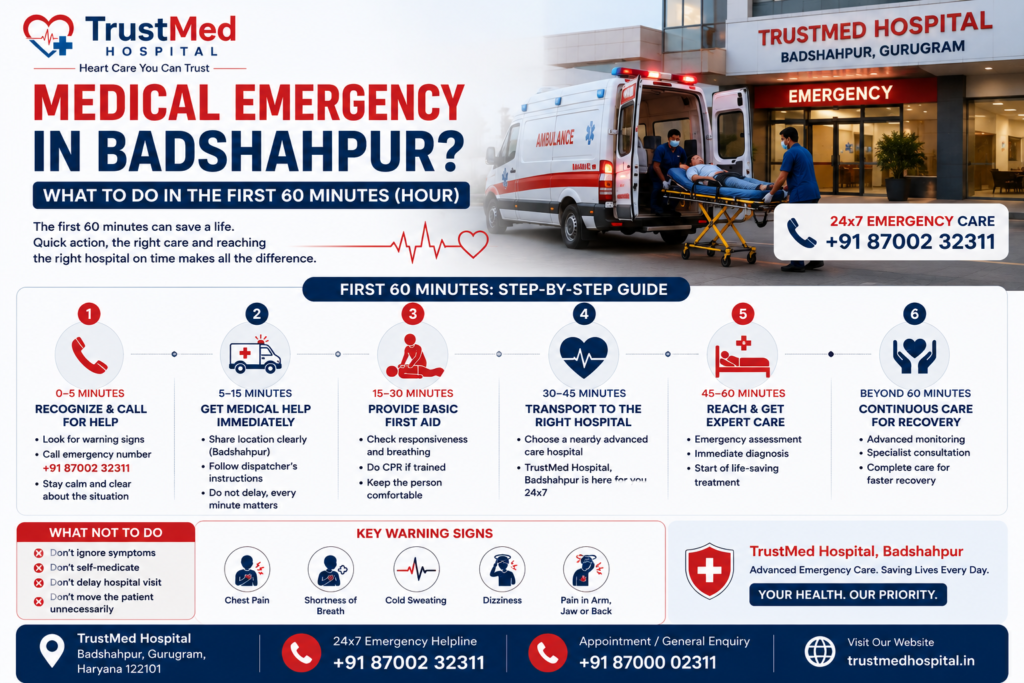
Recognising the emergencies where minutes matter
Heart attack
Signs: chest pain or heaviness, often spreading to the left arm, jaw, neck or back; breathlessness; cold sweat; nausea; sudden severe fatigue.
Note that women, elderly people and people with diabetes frequently present without classic chest pain — instead with breathlessness, unusual fatigue, or discomfort mistaken for indigestion. This is one of the most common reasons cardiac events are missed at home.
Do: call the hospital and get moving immediately. Keep the person sitting, calm and still. Do not: wait to see if it passes. This is the single most common and most costly mistake.
Stroke
Use the BE FAST check:
- Balance — sudden loss of balance or coordination
- Eyes — sudden loss or blurring of vision
- Face — one side of the face drooping when they try to smile
- Arms — one arm drifting down when both are raised
- Speech — slurred, confused, or unable to speak
- Time — note the exact time symptoms started and go now
That last point is critical. Clot-dissolving treatment for stroke is only possible within a limited time window from symptom onset, so the treating team will ask when symptoms began. If someone woke with symptoms, the relevant time is when they were last seen normal.
Do not give food, water or medication to someone with stroke symptoms — swallowing is often affected and they may choke.
At the time of emergency in Road accident or major injury
Do: call for help, control visible bleeding with firm direct pressure using a clean cloth, and keep the person warm. Do not: move anyone with a suspected head, neck or spine injury unless they are in immediate danger, and do not remove a helmet from an injured motorcyclist. Both risk converting a survivable injury into a permanent one.
Our existing guide to first aid for accident victims covers this in more detail.
Severe breathing difficulty (in emergency)
Signs: gasping, inability to speak a full sentence, bluish lips or fingertips, chest visibly drawing in with each breath. Do: sit them upright — never flat — loosen tight clothing, use a prescribed inhaler if they have one, and go to hospital immediately.
Other conditions needing emergency care without delay
- Seizure lasting more than five minutes, or a first-ever seizure
- Sudden severe abdominal pain with vomiting
- Heavy bleeding that does not stop with pressure
- Suspected poisoning or overdose — carry the container or strip with you
- High fever with confusion, stiff neck or a rash
- Any loss of consciousness, even if the person recovers quickly
What to bring
Keep this list on your phone:
- All current medications, or clear photographs of them
- Health insurance card or policy number
- Aadhaar or any photo ID
- Previous discharge summaries or reports, if the condition is a known one
- A charged phone, and one family member who can stay and give consent
Mistakes that cost time at time of emergency
Waiting to see if it improves. The most common error in cardiac and stroke emergencies, and the most damaging.
Driving to a hospital that cannot treat it. A clinic without an ICU, ventilator support or an operating theatre will stabilise and transfer — which means doing the journey twice. For anything potentially serious, go directly to a hospital with critical care facilities.
Giving food or water. If surgery or a procedure is needed, an empty stomach matters. Withhold food and water until a doctor has assessed the patient.
Not noting the time. Write down when symptoms started. You will be asked, and under stress people genuinely cannot recall.
Everyone crowding the emergency room. One or two family members who know the medical history. A crowd slows the team down and helps nobody.
Know your nearest emergency hospital before you need it
Take two minutes today: save your nearest emergency number in your phone, and check the route. In an emergency you should not be searching for a hospital — you should already know where you are going.
TrustMed Hospital runs a 24/7 emergency department on Badshahpur Sohna Road, near Sector 67 Gurgaon, serving Badshahpur, Bhondsi, Sohna Road and the surrounding Sector 65–70 area.
We have on-site ICU and ventilator support, a NICU for newborn emergencies, a modular operation theatre for emergency surgery, and cashless insurance processing — so treatment starts before paperwork does.
24/7 Emergency 📞 +91-8700232311 | +91-8700002311 📍 Plot 137, Badshahpur Sohna Road, Near Sector 67, Bhondsi, Gurugram, Haryana 122101
Frequently Asked Questions during emergency before visit hospital
Which is the nearest emergency hospital to Badshahpur and Sector 67? TrustMed Hospital operates a 24-hour emergency department on Badshahpur Sohna Road near Sector 67, Bhondsi, with ICU, NICU and emergency surgery facilities on site.
Should I call an ambulance or drive to the hospital? Call an ambulance where one is quickly available, particularly for suspected heart attack, stroke, spinal injury or unconsciousness — treatment can begin en route. If driving is genuinely faster, have someone else drive and call the hospital before you set off.
What is the golden hour? The first hour after a serious medical event, during which treatment is most effective at preventing permanent damage or death. It applies particularly to heart attack, stroke and major trauma.
Is emergency treatment available on a cashless basis? Yes, with insurers we are empanelled with. In an emergency, treatment begins first and insurance formalities are handled in parallel by our insurance desk. See our guide to how cashless hospitalization works.
What should I not do while waiting for medical help? Do not give food or water, do not move someone with a suspected spinal injury, do not remove a helmet after a road accident, and do not give any medication that has not been prescribed for that situation.
This article is for general awareness and does not replace emergency medical care. In a medical emergency, contact a hospital or emergency service immediately.