Cashless Treatment in Gurgaon: 10 FAQs Patients Ask (2026 Guide)

Orthopedic Problems in Adults: 7 Warning Signs You Shouldn’t Ignore
July 27, 2026
Heart Treatment: Everything You Need to Know About Modern Cardiac Care
July 29, 2026
If you or a family member need hospital care, one of the first questions on your mind is probably about cost. Fortunately, cashless treatment in Gurgaon has made hospital admissions far less stressful for thousands of families every year. Whether you need surgery, maternity care, pediatric treatment, or emergency support, understanding how cashless treatment works — and how it applies across different hospital departments — can save you time, money, and unnecessary confusion during an already difficult moment.
This guide walks you through everything patients typically search for around cashless treatment in Gurgaon, department by department, so you know exactly what to expect no matter which part of the hospital you need.
What Is Cashless Treatment in Gurgaon?
Cashless treatment in Gurgaon allows patients to receive hospital care without paying the covered treatment cost upfront from their own pocket. Instead, the hospital bills your insurance company or TPA (Third Party Administrator) directly, based on your policy terms. This system is available at many multi-speciality hospitals across Gurgaon, including areas like Badshahpur, Sector 67, and Bhondsi, and it applies across departments such as general surgery, gynecology, pediatrics, orthopedic care, neurology, medicine, and critical care units like ICU and NICU.
How Does Cashless Treatment Work at a Multi-Speciality Hospital in Gurgaon?
Every hospital department has slightly different documentation needs, but the general cashless treatment process across a multi-speciality hospital in Gurgaon typically follows these steps:
- Visit the hospital’s insurance or TPA desk with your insurance card and ID proof.
- Mention the specific department you’re being admitted to — for example, general surgery, gynecology, pediatrics, orthopedic, neurology, or ICU — since coverage terms can vary by treatment type.
- The hospital’s insurance team verifies your policy and sends a pre-authorization request to your insurer.
- Once the cashless treatment request is approved, you’re admitted to the relevant department without paying the covered amount upfront.
- At discharge, your insurer settles the eligible bill directly with the hospital’s respective department.
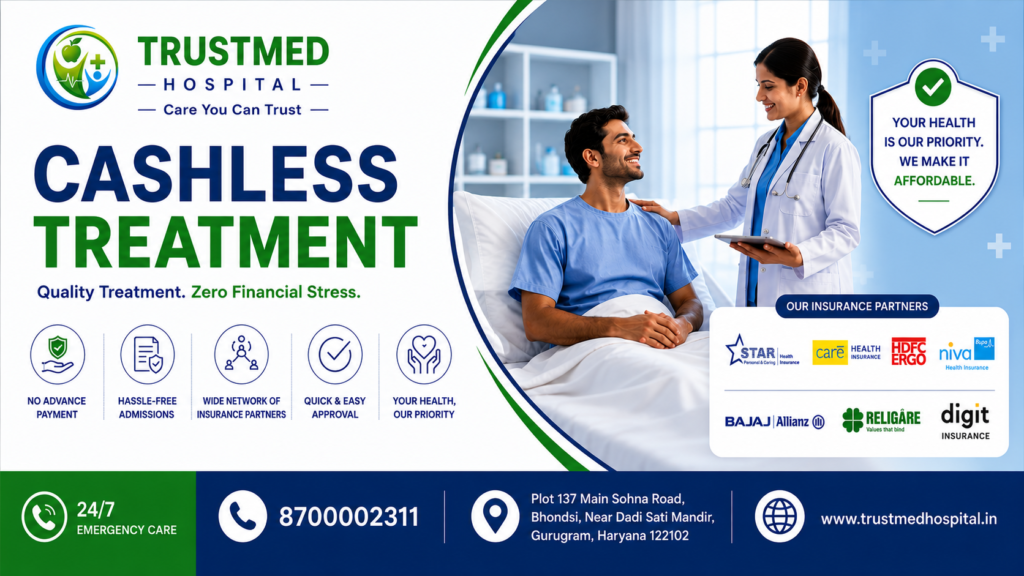
Cashless Treatment for General Surgery in Gurgaon
Surgical procedures are one of the most common reasons patients look for cashless treatment in Gurgaon hospitals. Whether it’s a planned laparoscopic surgery, a hernia repair, gallbladder removal, or an appendectomy, most general surgery departments in Gurgaon hospitals support cashless treatment for patients with valid health insurance. Before scheduling surgery, it’s important to confirm with the hospital’s general surgery and insurance desk whether your specific procedure and hospital are within your insurer’s network, since surgical packages often have separate approval requirements compared to general hospitalization.
Cashless Treatment for Maternity and Gynecology Care in Gurgaon
Pregnancy and delivery are significant life events, and many expecting parents specifically search for cashless treatment for maternity care in Gurgaon hospitals. Gynecology departments typically offer cashless treatment for both normal delivery and C-section procedures, subject to your policy’s maternity waiting period and coverage limits. Since maternity coverage varies significantly between insurance policies — some plans exclude maternity entirely, while others cap the amount — it’s strongly recommended that expecting mothers confirm cashless treatment eligibility for gynecology and maternity admission well before the expected delivery date, rather than waiting until labor begins.
Cashless Treatment for Children: Pediatrics and NICU in Gurgaon
When it comes to children’s health, parents want quick, stress-free access to care. Cashless treatment for pediatric admissions in Gurgaon hospitals covers common childhood illnesses, infections, and planned pediatric procedures, depending on your insurance policy’s terms for dependent children. For newborns requiring specialized care, the NICU (Neonatal Intensive Care Unit) is a critical department where cashless treatment can make a significant difference, since NICU stays can be lengthy and costly. Parents should check whether their maternity policy separately covers NICU admission for the newborn, as some insurance plans treat mother and baby as separate cashless treatment claims.
Cashless Treatment for Orthopedic Care in Gurgaon
Bone and joint problems — from fractures to joint replacements — are another major category where patients look for cashless treatment in Gurgaon hospitals. Orthopedic departments typically support cashless treatment for both non-surgical care, like physiotherapy-based management, and surgical interventions such as fracture fixation, arthroscopy, or joint replacement surgery. Because orthopedic surgeries like knee or hip replacement can be expensive, patients are advised to check their policy’s sub-limits specifically for orthopedic and joint-replacement procedures, as some insurers cap these separately from general surgical cover.
Cashless Treatment for Neurology Cases in Gurgaon
Neurological conditions, including stroke, seizures, and chronic nerve disorders, often require urgent hospitalization, making cashless treatment especially important in the neurology department. Many Gurgaon hospitals with a dedicated neurology department support cashless treatment for both emergency neurological admissions and planned treatments like diagnostic testing or nerve-related surgeries. Given that neurological emergencies like stroke require immediate action, hospitals typically begin treatment first and process cashless treatment pre-authorization in parallel, so that critical time isn’t lost waiting for insurance approval.
Cashless Treatment in ICU (Intensive Care Unit) in Gurgaon
Critical care is often the most expensive part of hospitalization, which is why cashless treatment in the ICU matters so much to patients and families. ICU admissions in Gurgaon hospitals are generally covered under cashless treatment for patients with adequate insurance coverage, though the duration and per-day cost covered can vary by policy. Because ICU stays can extend unpredictably depending on a patient’s condition, families should stay in close contact with the hospital’s insurance desk throughout the admission to track how much of the cashless treatment cover remains and whether any additional authorization is needed.
Cashless Treatment for ENT Conditions in Gurgaon
Ear, nose, and throat conditions — ranging from chronic sinusitis to tonsillectomy — are increasingly common reasons for hospital visits, and cashless treatment is generally available for ENT department admissions in Gurgaon hospitals, both for medical management and minor surgical procedures. As with other departments, it’s worth confirming with the ENT and insurance team in advance whether a specific procedure, such as a septoplasty or tonsillectomy, falls under your policy’s day-care or full hospitalization cashless treatment category, since some ENT procedures are classified as day-care surgeries with different documentation requirements.
Cashless Treatment Under the Medicine Department in Gurgaon
The general medicine department handles a wide range of conditions, from viral infections and diabetes management to hypertension-related hospitalization. Cashless treatment for general medicine admissions in Gurgaon hospitals is usually among the most straightforward to process, since these are common, well-documented conditions that most insurers recognize easily. Patients being admitted under the medicine department for fever, infections, or chronic disease management should still carry their insurance card and prior medical records, as this speeds up the cashless treatment approval process significantly.
Cashless Treatment for Road Accident Victims in Gurgaon (PM RAHAT Scheme)
One of the most important recent developments in cashless treatment is the PM RAHAT (Road Accident Victim Hospitalisation and Assured Treatment) Scheme, launched in February 2026. Under this scheme, any victim of a road accident involving a motor vehicle is eligible for cashless treatment coverage of up to ₹1.5 lakh, for up to seven days from the date of the accident, regardless of the road category where the accident occurred. This applies across Gurgaon and the rest of India, and importantly, it does not require the victim to have a personal health insurance policy — the scheme is funded through the Motor Vehicle Accident Fund, making cashless treatment for road accident victims accessible to everyone. Stabilisation treatment is provided for up to 24 hours in non-life-threatening cases and up to 48 hours in life-threatening cases, and hospitals begin cashless treatment immediately while pre-authorization for the accident case is processed alongside.
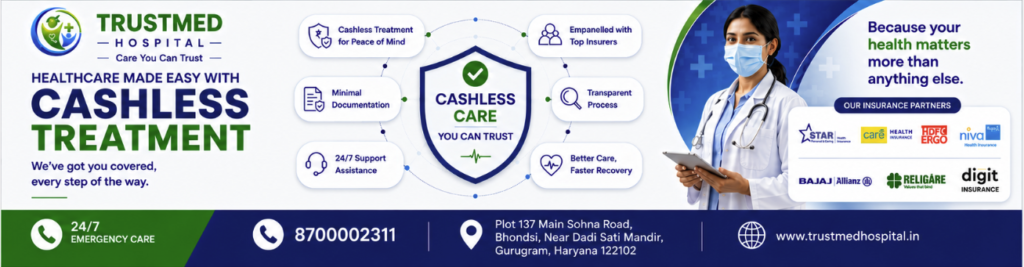
Documents Required for Cashless Treatment Across Hospital Departments in Gurgaon
Regardless of which department you’re being admitted to, most hospitals in Gurgaon require the following for cashless treatment approval:
- Valid health insurance card or policy number
- Government-issued photo ID (Aadhaar, PAN, passport, etc.)
- Policy details, including sum insured, validity, and department-specific sub-limits
- Doctor’s prescription or referral letter for planned admissions
- Previous medical records relevant to the department, such as prior surgical history for general surgery, antenatal records for gynecology, or diagnostic reports for neurology
For road accident cases under the PM RAHAT scheme, formal documentation is typically completed by the hospital in coordination with police records, so patients are not required to arrange separate paperwork before receiving cashless treatment.
Does Cashless Treatment Cover the Full Hospital Bill Across All Departments?
Here’s an elaborated version — expanded with more concrete examples, a clearer breakdown, and split into shorter paragraphs for readability (which also helps with your “long paragraph” Rank Math flag):
Does Cashless Treatment Cover the Full Hospital Bill Across All Departments?
Not necessarily. Cashless treatment coverage depends entirely on your specific insurance policy, and different hospital departments can have very different sub-limits, even under the same policy. Many patients assume that once cashless treatment is approved, the entire bill is taken care of — but insurers structure coverage department by department, and understanding these distinctions in advance can prevent unpleasant surprises at discharge.
For example, a policy might fully cover general medicine admissions — such as treatment for fever, infections, or diabetes management — with minimal restrictions, since these are considered low-risk, well-documented conditions. However, the same policy could cap orthopedic joint-replacement surgery at a fixed amount (say, ₹2–3 lakh for a knee or hip replacement), regardless of the hospital’s actual charges, leaving the patient responsible for any difference. Similarly, maternity and NICU care are often subject to separate, lower sub-limits than general hospitalization, and some policies apply a waiting period before maternity benefits become active at all.
Beyond department-specific sub-limits, certain categories of expenses are typically excluded from cashless treatment altogether, regardless of which department you’re admitted to. These commonly include:
- Non-medical consumables — items like gloves, syringes, disposable kits, or administrative charges that insurers classify as “non-payable” under IRDAI guidelines
- Co-payment clauses — where the policy requires the patient to bear a fixed percentage (often 10–20%) of the total bill, especially common in senior citizen policies
- Costs beyond the sum insured — once the total treatment cost crosses your policy’s coverage limit, the remaining balance must be paid out of pocket
- Room rent capping — some policies limit cashless treatment to a specific room category (e.g., general ward or semi-private), and choosing a higher category can trigger proportionate deductions across the entire bill, not just the room charge
For accident cases under the government’s PM RAHAT scheme, the coverage structure works differently from private insurance. Cashless treatment here is capped at ₹1.5 lakh per victim, for a maximum of seven days from the date of the accident. This cap applies regardless of the victim’s insurance status, but it also means that any treatment costs exceeding ₹1.5 lakh, or care needed beyond the seven-day window, are not covered under the scheme and would need to be arranged separately — either through the patient’s personal health insurance, if any, or out-of-pocket payment.
Given how much these terms can vary — by department, by policy, and by scheme — patients are strongly encouraged to ask the hospital’s insurance desk for a clear, written breakdown of what’s covered before treatment begins, rather than assuming “cashless” means “completely free.”
How Long Does Cashless Treatment Approval Take in Gurgaon Hospitals?
For planned admissions across departments like general surgery, gynecology, orthopedic, or ENT, cashless treatment pre-authorization in Gurgaon hospitals usually takes a few hours once complete documents are submitted. For emergency admissions — whether in the ICU, neurology department for stroke cases, or under the road accident scheme — hospitals typically begin treatment immediately, processing cashless treatment approval in parallel so that patient care is never delayed while waiting for paperwork.
What If My Cashless Treatment Request Is Rejected?
If a cashless treatment request is declined by your insurer, for any department, treatment can usually still proceed on a reimbursement basis — you pay upfront and later claim the eligible amount back from your insurer. Hospital insurance desks can typically help you understand the specific reason for rejection, whether it relates to a department-specific exclusion, a policy waiting period, or incomplete documentation, and guide you through the reimbursement process where cashless treatment isn’t possible.
Benefits of Choosing Cashless Treatment in Gurgaon
Choosing cashless treatment in Gurgaon offers several practical advantages for patients and families, regardless of which hospital department is involved. First, it removes the immediate financial burden of arranging large sums of money during a medical emergency, whether that’s an unplanned ICU admission, a sudden neurology case, or an urgent orthopedic fracture requiring surgery. Second, cashless treatment reduces the administrative back-and-forth for families, since the hospital’s insurance desk coordinates directly with the insurer or TPA rather than the patient having to manage reimbursement paperwork while also caring for a sick relative. Third, across departments like gynecology and pediatrics, cashless treatment allows families to focus on the wellbeing of the mother and newborn rather than worrying about billing during what is already an emotionally significant time. Finally, for hospitals offering cashless treatment across a wide range of departments — from general surgery to ENT to critical care — patients gain the flexibility to be treated for multiple, sometimes unrelated, conditions under the same admission without needing to separately arrange funds for each department involved.
Tips for a Smooth Cashless Treatment Experience in Gurgaon
To make the cashless treatment process as smooth as possible, regardless of which hospital department you’re being admitted to, keep the following in mind:
- Carry your insurance card and ID at all times — this is the first thing any hospital’s insurance desk will ask for when initiating cashless treatment, whether for a planned gynecology admission or an emergency neurology case.
- Know your policy’s department-specific exclusions in advance — many patients discover too late that their policy caps orthopedic surgery or maternity cover differently from general medicine admissions, so reviewing your policy document before a planned procedure can prevent surprises.
- Inform the hospital early for planned admissions — for departments like general surgery, orthopedic, or ENT where procedures are scheduled in advance, informing the hospital’s insurance desk a few days ahead allows more time for cashless treatment pre-authorization to be processed smoothly.
- Keep prior medical records handy — whether it’s previous scans for a neurology case, antenatal records for gynecology, or growth charts for a pediatric admission, having these ready speeds up the cashless treatment approval process considerably.
- Ask about day-care procedures separately — some ENT, orthopedic, or general surgery procedures are classified as day-care surgeries rather than full hospitalization, and cashless treatment documentation can differ slightly for these cases.
- For accident cases, call 112 immediately — this connects victims to the nearest hospital designated for cashless treatment under the PM RAHAT scheme, ensuring faster access to emergency and critical care.
- Stay in touch with the insurance desk during ICU stays — since ICU costs can accumulate quickly, checking in regularly on remaining cashless treatment cover helps families plan for any additional authorization that might be needed.
Why Department-Wise Understanding of Cashless Treatment Matters
Many patients assume that once a hospital is “empanelled for cashless treatment,” every department and procedure within that hospital is automatically and equally covered. In reality, insurance policies frequently apply different rules to different departments — a policy might offer generous cashless treatment for general medicine and pediatrics, while capping orthopedic joint-replacement surgery or excluding certain elective gynecology procedures. This is precisely why a department-wise understanding of cashless treatment in Gurgaon hospitals is so valuable: it helps patients ask the right questions before admission, rather than discovering coverage gaps at the time of discharge. Whether you’re dealing with a routine general surgery procedure, a high-risk neurology emergency, a scheduled orthopedic surgery, or a NICU admission for a newborn, taking five minutes to confirm department-specific cashless treatment terms with the hospital’s insurance desk can prevent unexpected costs later.
Common Myths vs Facts About Cashless Treatment in Gurgaon
Myth: Cashless treatment means the entire hospital bill is free. Fact: Cashless treatment only covers what your policy allows; department-specific sub-limits, co-payments, and non-medical charges may still apply.
Myth: You need insurance to get cashless treatment for a road accident. Fact: Under the PM RAHAT scheme, cashless treatment for road accident victims is available regardless of insurance status.
Myth: Cashless treatment approval always takes days. Fact: For emergencies across departments like ICU or neurology, treatment starts immediately, with approval processed in parallel.
Myth: All hospital departments have identical cashless treatment terms. Fact: Coverage often varies — maternity, orthopedic surgery, and ICU care may have different sub-limits within the same policy.
Frequently Asked Questions About Cashless Treatment in Gurgaon
1. What is cashless treatment in Gurgaon? It’s a system where the hospital bills your insurer or a government scheme directly, so you don’t pay eligible treatment costs upfront, across departments including surgery, maternity, pediatrics, orthopedic, neurology, and ICU.
2. Which hospital departments in Gurgaon offer cashless treatment? Most multi-speciality hospitals in Gurgaon offer cashless treatment across general surgery, gynecology, pediatrics, orthopedic, neurology, medicine, ICU, NICU, and ENT departments, subject to your insurance policy.
3. Is cashless treatment available for road accident victims without insurance? Yes. The PM RAHAT scheme provides cashless treatment up to ₹1.5 lakh for road accident victims, regardless of whether they hold a personal health insurance policy.
4. Does cashless treatment cover maternity and NICU care separately? Often, yes. Many policies treat maternity (mother) and NICU (newborn) as separate cashless treatment claims, so it’s important to confirm both before delivery.
5. What documents do I need for cashless treatment in Gurgaon hospitals? Generally, your insurance card, photo ID, policy details, and a doctor’s referral, along with department-specific medical records where applicable.
6. Can cashless treatment be denied for a specific department? Yes, certain departments or procedures may be excluded or capped by your specific policy, even if cashless treatment is generally available at the hospital.
7. How fast does cashless treatment start for ICU or neurology emergencies? Treatment typically begins immediately in emergencies, with cashless treatment pre-authorization processed alongside, so care is not delayed.
8. What happens if my cashless treatment request is rejected? You can usually still receive treatment and pay upfront, then claim reimbursement from your insurer afterward, once the reason for rejection is resolved.
9. Do all Gurgaon hospitals accept the same insurance providers for cashless treatment? No — network empanelment varies by hospital and insurer, so it’s important to confirm with the specific hospital’s insurance desk before admission to any department.
10. Who can I contact for cashless treatment queries across departments? Most hospitals, including TrustMed Hospital in Badshahpur, Gurgaon, have a dedicated insurance desk that can guide you through cashless treatment eligibility for any department you’re being admitted to.
Summary
Cashless treatment in Gurgaon spans every major hospital department — from general surgery and gynecology to pediatrics, orthopedic care, neurology, ICU, NICU, and ENT — but the exact coverage, documentation, and approval process can vary significantly by department and by your specific insurance policy. Since early 2026, the PM RAHAT scheme has also opened up cashless treatment for road accident victims regardless of insurance status, adding another important layer of protection for patients across Gurgaon. Understanding which route applies to your situation — personal insurance, department-specific sub-limits, or the government accident scheme — can make hospital admission significantly less stressful when it matters most.
Medical Disclaimer
This blog is for general informational purposes only. Cashless treatment eligibility depends on your specific insurance policy, insurer/TPA terms, department-specific coverage, and government scheme guidelines, which may be updated from time to time. Please verify current details with your insurance provider, the relevant government scheme portal, and the hospital’s insurance desk before admission.
TrustMed Hospital Is Just One Call Away
Need help understanding your cashless treatment options across any department in Gurgaon? Call our insurance desk at +91-8700232311 or visit trustmedhospital.in to check your eligibility before admission.