When Does a Newborn Need NICU Care? A Parent’s Guide

Knee Pain After 40: When to See an Orthopedic Doctor
July 29, 2026
Medical Emergency in Badshahpur? What to Do in the First 60 Minutes (Hour)
July 29, 2026
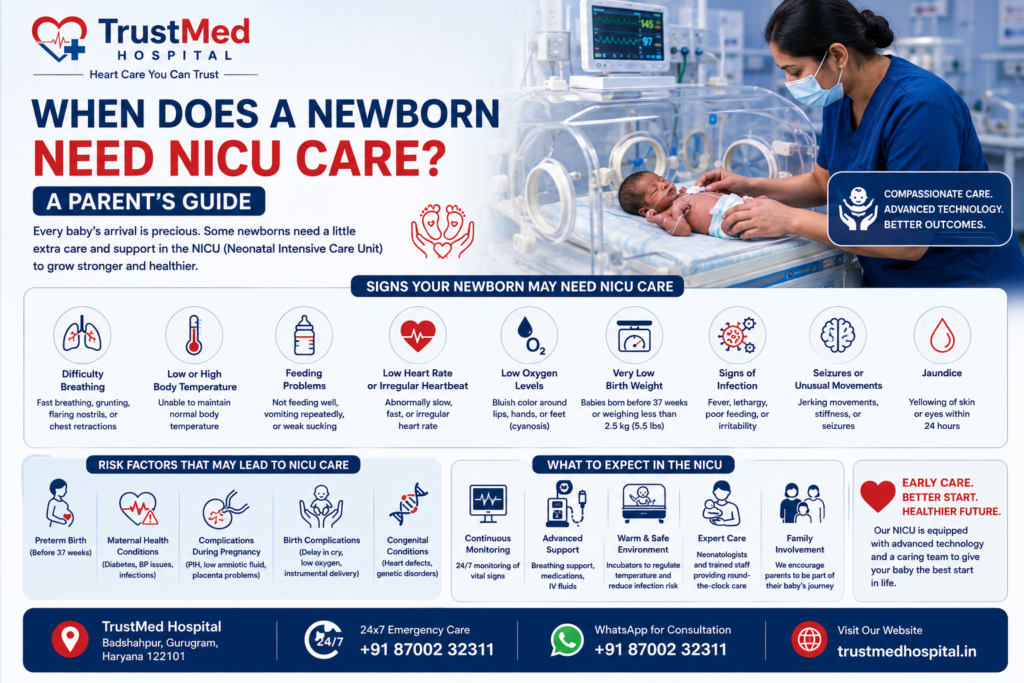
Hearing that your baby needs to go to the NICU is frightening — especially when it happens minutes after birth, before you have even had a chance to hold them. Most parents are handed a lot of unfamiliar words at once, and very little context.
This guide explains, in plain language, why babies are admitted to a neonatal intensive care unit, what the machines around the cot actually do, and what recovery usually looks like. As a NICU hospital in Gurgaon, our neonatal team has these conversations with families every week, and the single thing that helps most is knowing what to expect.
The most important thing to understand up front: a NICU admission is not a verdict. A large share of babies admitted to neonatal care are there for short, monitored, entirely recoverable reasons.
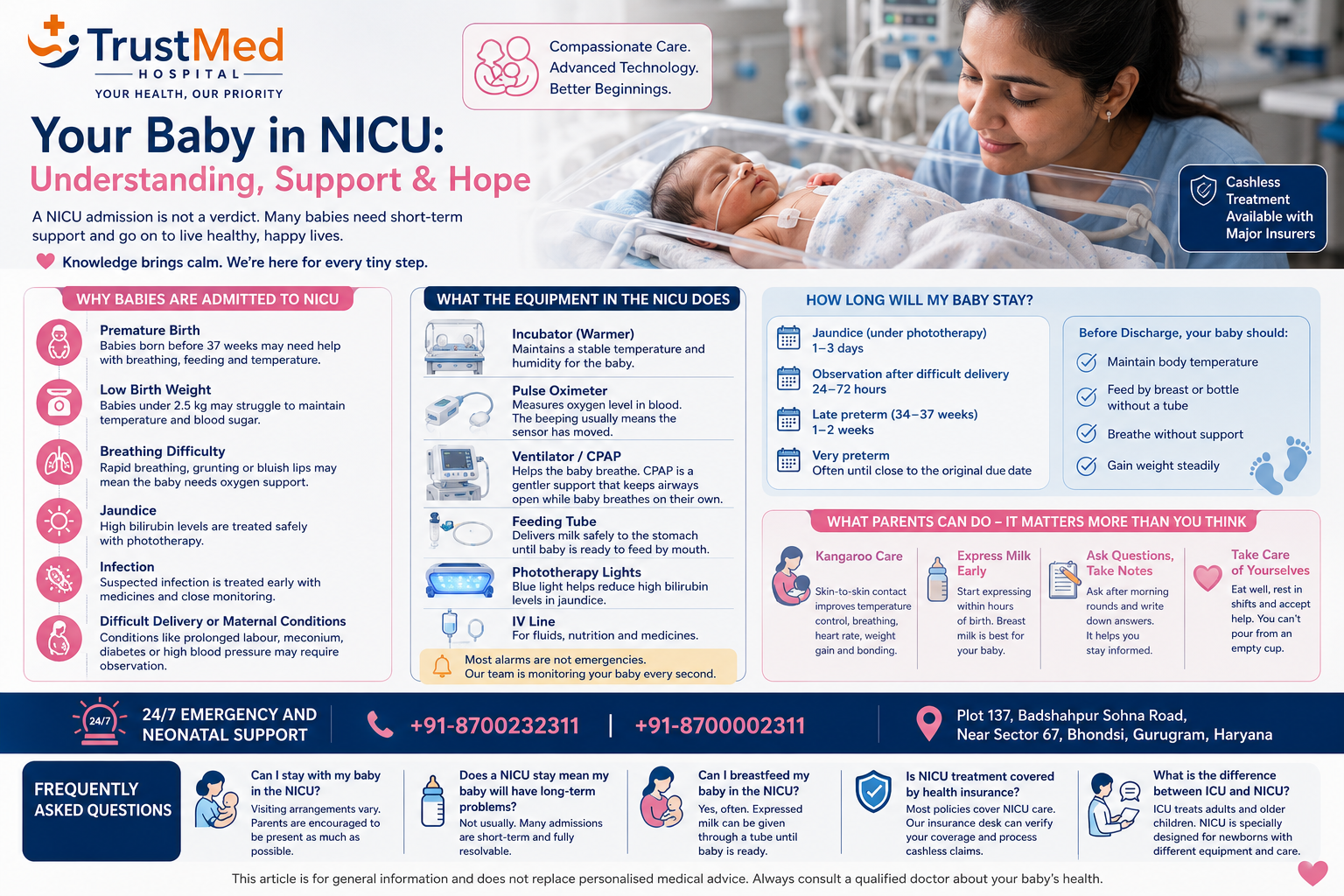
Why babies are admitted to the NICU
Premature birth
Babies born before 37 weeks may need help with breathing, feeding and maintaining body temperature simply because those systems have not finished developing. The earlier the birth, the more support is usually needed. Prematurity is the most common single reason for neonatal admission, and the World Health Organization estimates around one in ten babies worldwide is born preterm.
Low birth weight
Babies weighing under 2.5 kg often struggle to regulate their own temperature and blood sugar. A controlled environment and monitored feeding usually resolves this over days to weeks.
Breathing difficulty
Rapid breathing, grunting, flaring nostrils, or a bluish tinge to the lips and tongue signals that a baby is working too hard to breathe. Causes range from immature lungs to fluid retained in the airways after delivery — many are treatable quickly with oxygen support.
Jaundice
Newborn jaundice is very common and usually harmless. When bilirubin levels rise beyond a safe threshold, phototherapy is used to bring them down. This is one of the most frequent and most straightforward reasons for a short neonatal stay.
Infection
Newborn immune systems are still immature. Suspected infection is treated urgently and cautiously, often with antibiotics started before test results are back — because in newborns, waiting carries more risk than treating.
Difficult delivery or maternal conditions
Prolonged labour, meconium in the amniotic fluid, or maternal conditions such as gestational diabetes or high blood pressure can all mean a baby needs observation for the first 24 to 72 hours.
What the equipment in the NICU actually does
The machines look alarming. Most of them are doing something simple.
- Incubator (warmer): maintains a stable temperature and humidity, because premature babies lose body heat very quickly.
- Pulse oximeter: the small light-up sensor taped to the hand or foot. It measures oxygen in the blood. This is what triggers most of the beeping.
- Ventilator or CPAP: supports breathing. CPAP is gentler — it keeps the airways open with pressurised air while the baby breathes independently.
- Feeding tube: a fine tube through the nose or mouth into the stomach. Babies under roughly 34 weeks often have not yet developed a coordinated suck-swallow-breathe reflex, so this delivers milk safely until they do.
- Phototherapy lights: blue light that breaks down bilirubin in jaundice.
- IV line: delivers fluids, nutrition or medication.
On the alarms: monitors are set with deliberately sensitive thresholds. Most alarms mean a sensor has slipped or a baby has wriggled — not that something is wrong. The nursing team knows the difference at a glance. Ask them; they would far rather explain than have you sit in silent panic.
How long will my baby stay in NICU?
There is no single answer, but a rough guide:
- Jaundice under phototherapy: commonly 1–3 days
- Observation after a difficult delivery: 24–72 hours
- Late preterm (34–37 weeks): often 1–2 weeks
- Very preterm: frequently until close to the original due date
Neonatologists generally look for the same set of milestones before discharge: the baby maintains their own body temperature, feeds by breast or bottle without a tube, breathes without support, and gains weight steadily.
What parents can do — and it matters more than you think
Feeling useless is one of the hardest parts of a NICU stay. You are not.
Kangaroo care. Skin-to-skin contact, where the baby’s condition allows it, is not just comforting. It is associated with better temperature regulation, more stable heart rate and breathing, improved weight gain and better breastfeeding outcomes. Ask your neonatal team when you can start.
Express milk early and regularly. Breast milk is significant for premature babies, and starting expression within the first hours after birth helps establish supply. The nursing staff can guide you.
Ask questions and take notes. Ask at the same point each day if you can — after the morning round, when the team has the latest results. Write down the answers. Nobody retains medical information well under stress.
Look after yourselves. Recovery from delivery is real, and NICU stays are long. Eat, sleep in shifts, and let family help.
When to seek help after discharge from NICU
Once home, contact your pediatrician or come to the hospital promptly if your baby shows:
- Fever, or an unusually low temperature
- Refusing feeds, or feeding far less than usual
- Rapid, laboured or grunting breathing
- Yellowing of the skin or eyes that is spreading or deepening
- Unusual drowsiness, floppiness, or being very difficult to wake
- Fewer wet nappies than normal
Newborns can change condition quickly. Getting a baby checked and being told all is well is always the right call.
Neonatal care at TrustMed Hospital
Our NICU in Badshahpur, near Sector 67 Gurgaon, provides specialised care for premature and critically ill newborns, supported by our Pediatrics department and Gynecology and maternity services — so mother and baby are cared for under one roof.
We also offer cashless treatment with major insurers, which removes at least one worry during an already difficult week.
24/7 Emergency and Neonatal Support 📞 +91-8700232311 | +91-8700002311 📍 Plot 137, Badshahpur Sohna Road, Near Sector 67, Bhondsi, Gurugram
Frequently Asked Questions about NICU care in hospital
Can I stay with my baby in the NICU? Visiting arrangements vary between hospitals and depend on infection-control requirements. Parents are generally encouraged to be present as much as possible, particularly for kangaroo care and feeding. Ask your unit about their specific timings.
Does a NICU stay mean my baby will have long-term problems? Not usually. Many admissions are for short, fully resolvable reasons such as jaundice or brief observation. Where prematurity is significant, follow-up developmental checks are scheduled — your neonatologist will explain what is relevant to your baby specifically.
Can I breastfeed a baby in the NICU? Often yes, and it is actively encouraged. If your baby is not yet able to suck effectively, expressed milk can be given through a feeding tube until they are.
Is NICU treatment covered by health insurance? Most health insurance policies cover neonatal intensive care, though newborn cover terms and waiting periods vary by policy. Our insurance desk can verify your coverage and process a cashless claim.
What is the difference between ICU and NICU? An ICU treats critically ill adults and older children. A NICU is designed specifically for newborns, with different equipment, drug dosing and specialist neonatal staff.
This article is for general information and does not replace personalised medical advice. Always consult a qualified doctor about your baby’s health.