Knee Pain After 40: When to See an Orthopedic Doctor

Angioplasty vs Bypass Surgery: Which Heart Treatment is Right for You?
July 29, 2026
When Does a Newborn Need NICU Care? A Parent’s Guide
July 29, 2026
Don't ignore persistent knee pain after 40. Learn the warning signs, common causes, and effective non-surgical treatment options from the orthopedic specialists at TrustMed Hospital, Gurgaon.
Most people over 40 treat knee pain as a fact of life. It aches on the stairs, it stiffens after a long drive, it complains on the first cold morning of winter — and it gets managed with a painkiller and a shrug. Knowing when knee pain treatment in Gurgaon is genuinely needed, rather than waiting it out, is what keeps people out of an operating theatre later.
That is understandable, and often harmless. But some knee pain is a joint quietly deteriorating, and the difference between the two matters enormously, because early intervention is what keeps people out of an operating theatre later. Anyone searching for knee pain treatment in Gurgaon usually does so after months of waiting. It rarely needs to be that long.
Here is how to tell what your knee is actually telling you.
Knee pain treatment in Gurgaon: What You Should Know
Understanding knee pain treatment in gurgaon properly, rather than relying on assumptions, is what actually keeps people safe and helps them get the right care at the right time. The World Health Organization publishes guidance on this topic that supports the approach we follow at TrustMed Hospital.
Why knees start hurting in your forties
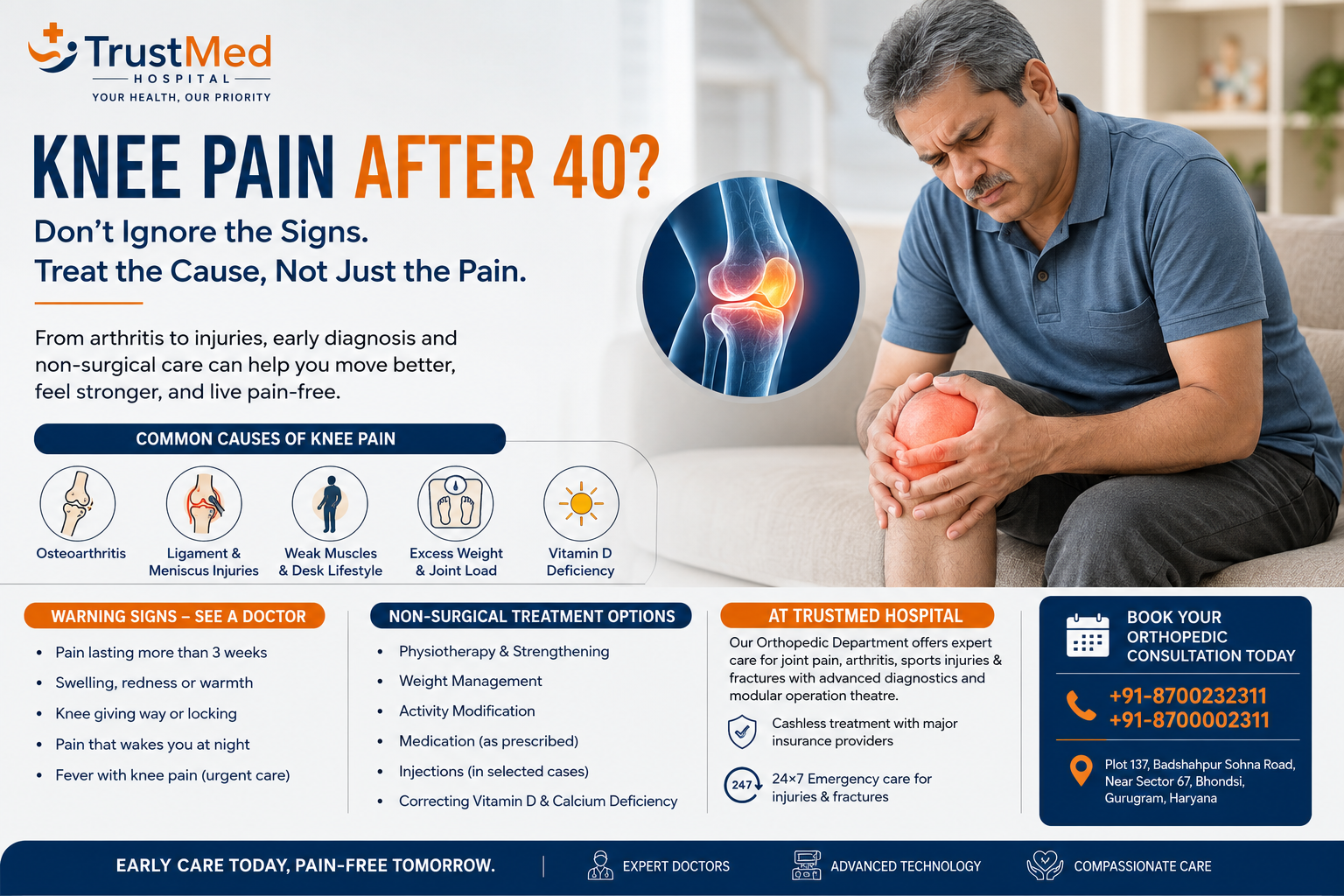
Osteoarthritis
The most common cause. The cartilage cushioning the joint gradually thins, so bone surfaces move with less protection. Typical signs: pain that worsens through the day, stiffness in the morning that eases within about 30 minutes, and a grinding or crackling sensation on movement.
Ligament and meniscus injuries
The meniscus — the shock-absorbing cartilage inside the knee — becomes more brittle with age. In your twenties it takes a sports injury to tear one. In your fifties, an awkward twist while getting out of a car can do it. Sudden pain, swelling, catching or locking of the joint points this way.
Weight and joint load
The knee carries several times body weight during ordinary activities such as climbing stairs. Even modest weight loss translates into a substantially larger reduction in load through the joint. This is why weight management is genuinely one of the most effective interventions for knee pain, not just standard advice.
Muscle weakness and desk work
Gurgaon’s long office hours and long commutes weaken the quadriceps and glutes. When those muscles do not stabilise the knee, the joint absorbs stress it was not designed to take alone. A great deal of knee pain in office workers is fundamentally a hip and thigh strength problem.
Vitamin D and calcium deficiency
Widespread in urban India, particularly among people who spend most daylight hours indoors. Deficiency affects bone health and muscle function, and is easily checked with a blood test.
Inflammatory arthritis
Less common but important to identify. Rheumatoid and other inflammatory arthritis tend to affect joints on both sides of the body, cause prolonged morning stiffness lasting over an hour, and may come with fatigue or visible swelling. This needs specialist assessment rather than symptomatic treatment.
Warning signs that need an orthopedic doctor
See a doctor rather than waiting if you have:
- Pain that has persisted more than three weeks despite rest
- Visible swelling that does not settle
- The knee giving way or feeling unstable when you put weight on it
- Locking or catching — the joint sticking mid-movement
- Pain that wakes you at night
- Redness and warmth with fever — this needs urgent attention, as joint infection is a medical emergency
- Inability to bear weight after an injury
- A visible change in leg alignment — bowing or knock-knee developing over time
Pain that wakes you at night and pain with fever are the two that people most often dismiss and most should not.
What non-surgical treatment involves
Surgery is the last option, not the first. Most patients improve significantly without it.
Physiotherapy and targeted strengthening. The most effective long-term intervention for osteoarthritis. Strengthening the quadriceps, hamstrings and glutes reduces load on the joint itself. It requires consistency over weeks — but it works, and the effect lasts.
Weight management. Discussed above, and worth repeating because the effect on knee load is disproportionate to the weight lost.
Activity modification. Not stopping activity — the opposite. Swimming, cycling and walking on flat ground maintain joint health with far less impact than running, stairs or deep squatting. Sitting cross-legged on the floor and using Indian-style toilets place particularly high stress on arthritic knees.
Medication. Anti-inflammatories provide relief but treat the symptom, not the cause. They should be taken under medical supervision — prolonged unsupervised use carries real risks to the stomach and kidneys.
Injections. In selected cases, corticosteroid or hyaluronic acid injections can provide relief when other measures have plateaued. Whether they are appropriate depends on your specific diagnosis.
Correcting deficiencies. If vitamin D or calcium levels are low, correcting them supports everything else you are doing.
What to expect at your consultation
A first orthopedic visit is straightforward:
- History — when it started, what makes it worse, previous injuries, how it affects daily life
- Physical examination — range of movement, stability, swelling, alignment, and how you walk
- Imaging if needed — an X-ray shows joint space narrowing and bone changes; an MRI is ordered only when a soft-tissue injury such as a meniscus or ligament tear is suspected
- Blood tests if inflammatory arthritis is suspected, or to check vitamin D
- A treatment plan — usually starting conservatively
Come prepared. Bring previous X-rays or reports, a list of medications you take, and a note of which specific activities trigger the pain. It makes the consultation considerably more useful.
Orthopedic care at TrustMed Hospital
Our Orthopedic department in Badshahpur, near Sector 67 Gurgaon, treats joint pain, arthritis, sports injuries and fractures, with diagnostic imaging and a modular operation theatre on site should surgical treatment become necessary.
We provide cashless treatment with major insurance providers, and our emergency department handles acute injuries and fractures around the clock.
Book an orthopedic consultation 📞 +91-8700232311 | +91-8700002311 📍 Plot 137, Badshahpur Sohna Road, Near Sector 67, Bhondsi, Gurugram
Frequently Asked Questions
Is knee pain after 40 normal? Occasional stiffness is common as joints age. Persistent pain lasting more than three weeks, swelling, or instability is not something to accept — those warrant assessment.
Will I definitely need a knee replacement? No. The large majority of patients with knee osteoarthritis are managed successfully without surgery. Replacement is considered only in advanced cases where pain significantly limits daily life despite conservative treatment.
Does climbing stairs make knee arthritis worse? Stairs place high load on the knee and often provoke pain, but avoiding movement entirely weakens the supporting muscles and worsens the problem. The aim is to modify activity, not stop it — your physiotherapist can guide the balance.
Can knee pain be treated without surgery? In most cases, yes. Physiotherapy, strengthening, weight management, activity modification and appropriate medication resolve or substantially improve most knee pain.
Should I get an MRI for knee pain? Not usually as a first step. An X-ray is generally sufficient for suspected arthritis. MRI is reserved for suspected ligament or meniscus injuries, and should follow a clinical examination rather than precede one.
This article is for general information and does not replace personalised medical advice. Consult a qualified orthopedic doctor for diagnosis and treatment.